Sunday, November 4, 2007

BBQ Class for the Teacher

Mmmm... ribsIn 1995, I decided to combine my passion for food and cooking with my love of teaching, and began teaching cooking classes. I started by teaching through the local Continuting Educaton Program. After less than a year, I built up a bit of a following and decided to go into business for myself. However, despite my busy schedule running a small business and teaching classes at my house each week, I still make time to teach for the Continuing Education Program that took a chance on a passionate home cook and gave me my start in this field.

Last month, as I was checking my listings in the catalog of classes sent out by Continuing Ed., I noticed a new class being offered through the program. "BBQ Passion: The Basics of Barbeque Cooking" was a new, one-time class and would be taught by the owner of a popular local barbeque restaurant. Bobby Q's of Westport, Connecticut, was featured on the FoodNetwork at one point last year, and has become somewhat of a hotspot for good barbeque in Fairfield County. My husband and I have been talking about installing an outdoor kitchen-barbeque at our home, and I figured it couldn't hurt to go learn from the experts before taking the plunge.


Being on "the other side of the counter" was definitely a fun experience. Bob LaRose, owner of Bobby Q's brought the class to the restaurant's rooftop deck, where a demonstration table was set up. Each participant received a multi-paged "book" with everything one would ever want to know about authentic barbeque, which, we learned, is entirely different from the backyard grilling we normally refer to as "barbeque". Grilling is cooking food on grates and over high heat for a relatively short period of time. Barbeque, on the other hand, is typically done with indirect heat or smoke, and requires several hours of cooking time. The Boston Butt pork Bobby Q's uses to make their most popular menu item, pulled pork, is cooked for almost 20 hours!

We started with dry rubs. We sampled basic rubs, fancy rubs, sweet rubs, and spicy rubs. Dry rubs are the cornerstone of barbeque at the restaurant, and the chef demonstrated how he applies rubs to racks of ribs, briskets, and Boston Butt (which, is not the "butt" at all, but rather a cut of meat from the pig's shoulder). We discussed which cuts of meat marry better with which rubs (the chef prefers brown sugar rubs with pork and granulated, white sugar rubs with beef and chicken).

We then talked about sauces, which at Bobby Q's, are used primarily for dipping tableside. Again, we sampled a wide variety of sauces to determine which flavors were our favorites. We covered home smokers, types of wood for smoking, and how to tell when something is ready to eat. Then, finally, came the eating!


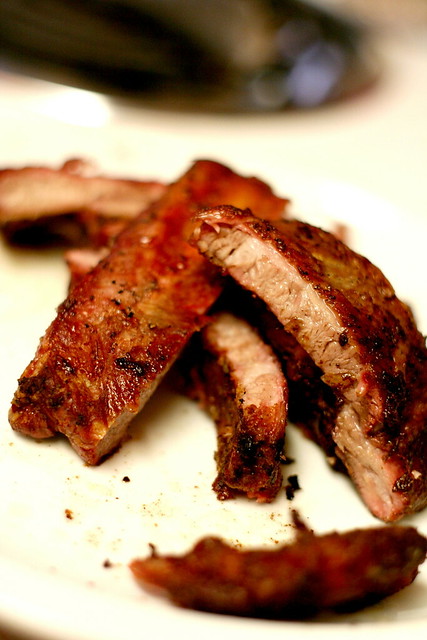
First we tasted the St. Louis Ribs, which are smoked with a simple rub. According to Bobby, "authentic" barbeque is supposed to have a little "pull" to the meat (meaning you need to work a bit to get it off the bone), the ones we tried were as tender as could be, and literally fell off the bone into your mouth. He noted that in the northeast, people tend to like the more tender meat, so he gives the people what they want. He also stated that while in other parts of the country, people prefer the St. Louis style ribs, here in Connecticut, the Baby Backs are by far the better sellers. Different demographic, different tastes.


It was time to move indoors into the kitchen, where we gathered around the smoker large enough to shelter a small family (a mere $25,000, if you're in the market for one). When the door opened, we saw a gigantic Boston Butt coming around on the rotisserie, which operated much like a ferris wheel (the meat sitting on one of the "seats", which is really a large, moving rack). Luckily for us, it was just ready to come out of the smoker, so the chef pulled it out, deboned it (the bone literally slid right out), and began to shred the meat. To say it was tender would be an understatement. Then the brisket came out. I felt this particular cut had been a bit dry and overcooked (and the chef concurred), but it was still decent. It perhaps just needed some of that tableside dipping sauce to moisten it up.


All in all, the class was informative and fun. It didn't surprise me that the participants were mostly men, whereas my classes consist almost exclusively of women. I suppose people consider barbeque more "manly" than other types of cooking. Manly or not, it is certainly one-sloooow-process, for which I'm not sure I have the patience. The results are great, but waiting 8 hours for some ribs to cook is not my kind of weekend activity. I think I'll leave the smoking to Bobby Q's.

Sunday, October 28, 2007

The Great Pumpkin

Pumpkins
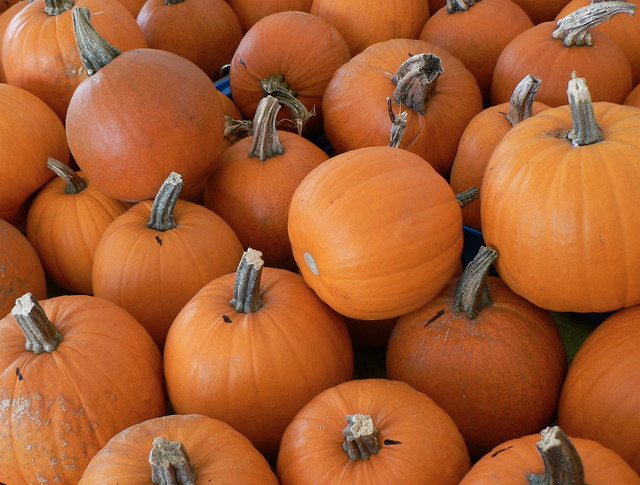
Lately, it seems as if the blog-gods have been willing me to write about pumpkins...and since it is almost Halloween, why not? Everywhere I turn I see pumpkin-flavored foods----my neighborhood ice cream parlor has pumpkin ice cream on special, Starbuck's reportedly has pumpkin scones (although I've only heard about them!), my mother sent me a recipe for pumpkin soup, and then, last Sunday, one of my favorite local breakfast spots, The Blue Bird Inn in Easton, Connecticut, featured Pumpkin Walnut Pancakes with Maple Butter. I went to brunch with the intention of having eggs and whole wheat toast, but when I saw the featured pancakes, all thoughts of protein and whole grains went out the window.

The generously-sized pancakes were sweeter and moister than traditional buttermilk pancakes, and slightly more dense. The walnuts gave a nice crunch, but did not overpower the texture. While they would have been good with regular butter, the maple butter was a great compliment to the pancakes. I chose to have mine with sausage instead of bacon on the side, because there is something about the combination of pumpkin and sausage that I love.

As soon as I got home, although stuffed to the gills, I started experimenting while the tasting memory was still fresh in my mind. I decided to use canned pumpkin and a multi-grain pancake mix to simplify the process. By adding a variety of spices and whipping up some maple butter, the result was just as good as the Blue Bird's. Now if I could only borrow their dishwasher!

Enjoy this dish on Halloween or Thanksgiving morning, or any other crisp, fall weekend that beckons for a visit from the Great Pumpkin!

Short-cut Pumpkin Pancakes with Walnuts and Whipped Maple Butter
Serves 4.
2 cups multi-grain pancake mix
1 cup milk
1/2 cup canned pumpkin puree
2 Tablespoons canola oil
1 t cinnamon
1/4 t freshly ground nutmeg
1/2 cup walnut halves
Non-stick cooking spray

Whisk all ingredients except walnuts in a large bowl until smooth. Gently fold in walnuts.

Spray a griddle or large frying pan with non-stick cooking spray, and scoop approximately 1/4 cup of batter onto hot pan.

Cook until some tiny bubbles begin to appear on top of the pancake, and flip (because of the density of the pancakes, you'll see fewer "bubbles" than with regular pancakes, so check the underside before flipping). Cook an additional minute or two, or until golden brown.

Serve hot with whipped maple butter (recipe follows) and syrup.


Whipped Maple Butter

1 stick unsalted butter, at room temperature
2 T maple syrup

Using an electric mixer, combine butter and maple syrup and beat until fluffy.
Serve with pumpkin-walnut pancakes.


Note: You can make this ahead of time by form maple butter into a log and wrap tightly in plastic wrap. Refrigerate until needed.


Monday, October 22, 2007

Salt Pig Love

Simply put, I love my salt pig. I bought it many years ago from a cooking catalog, which probably no longer exists. At the time, I wasn't even sure I would like it, and I'd never seen one in person, but the concept seemed like a good one. Up until that point, I kept my salt in a small ramekin on my counter top. It was perfectly serviceable, however, I often wondered if I was seasoning my food with a mixture of salt and dust. When I saw this "hooded" dish, it struck my fancy and I ordered it. It turned out to be one of my favorite accessories.


When teaching cooking classes in my home kitchen, my bright red salt pig draws quite a bit of attention. Many students have never seen one, and its name always elicits a laugh. In a nutshell, the salt pig is basically a ceramic salt cellar that is kept on the counter top. It's open-mouthed (or open-"snout") design gives cooks easy access to salt, the king of seasonings. You may be wondering why I just don't keep a salt shaker handy. The answer is simple: when "shaking" salt into a dish, it is very easy to misjudge the amount you are adding. Instead, if you scoop some salt into your hand and add it with your fingers, or better yet, use a measuring spoon, you'll have a much better sense of how much you're using. The salt pig is just a great way to store your salt (I prefer Kosher Coarse Salt or Coarse Sea Salt), and looks great on the counter next to your stove.

Salt pigs come in all sizes, but I prefer mine on the smaller side. It simply takes up less space on my counter, and I don't know of too many occasions where I'll need easy access to a pound of salt! Most come with a small ceramic or wooden spoon with which to scoop the salt, but other, wider mouth varieties are usually designed for a cook's fingers and come without a spoon. They all have the opening on the side, rather than the top, to prevent things from dropping into the salt, and many have a small knob on top to be used for moving it around the kitchen.


Salt pigs vary considerably in price too; designer salt pigs can run as high as $60, but most are under $30. Because I get so many questions about my salt pig during classes, I just started carrying stoneware salt pigs in my new web store. They hold 6 ounces of your favorite salt, and come in oatmeal or navy blue ( pictured above). They even have a cute pair of little piggie ears and a curly tail to boot!


While I am not much of a "gadget girl" in the kitchen, I don't know what I'd do without my beloved salt pig! Bring a pig into your kitchen too...you'll be happy you did.


Monday, October 15, 2007

Restaurants: Bloodroot, Bridgeport, CT


Bloodroot, on the water in Bridgeport, Connecticut, describes itself as a "feminist, vegetarian restaurant". That alone was enough to make me curious. I consider myself a feminist, and I definitely like vegetarian food, so when a friend suggested we plan a visit, I was game (naturally, as two full-time moms and part-time professionals, it took us literally six months to find a date, but we finally went!).


In the dark, finding Bloodroot is a bit of a challenge if you've never been there. Luckily, my friend was a returning visitor, so she directed me to the dimly lit restaurant which looks somewhat like a house. The entrance is on the side, through a lovely patio overlooking the harbor, where diners may eat during the warmer months. True to their philosophy of not being wasteful, all the exterior lights are on motion detectors and go on only when a person enters the patio. In a world of overlit public and retail spaces, it at first seems a bit disconcerting, but upon further contemplation, seems perfectly rational.


Upon entry to Bloodroot, one finds a warm, bohemian-vibed dining room with an open kitchen, and a small, feminist bookstore in the back, that almost beckons you to sit down and read something. The walls are simply adorned with dozens of old, sepia toned and black and white photographs of women. Regular women-- mothers, daughters, and sisters who were important in the lives of others. The menu is written on a chalkboard overhead, and features several seasonally appropriate vegetarian and vegan soups, salads and entrees. Nothing was priced above $17.

The protocal at Bloodroot is simple: make your selection from the chalkboard, place your order at the front desk, pay for your meal, and drop your meal ticket at the kitchen window. When your order is ready, your name will be called and the meal will be waiting for you on a tray at the counter. Don't forget to grab utensils and a napkin! If you want water or tea, you may serve yourself as well. The entire process is very egalitarian; you serve yourself and bus your own table. I like someone waiting on me as much as the next gal, but at Bloodroot it just feels right to do it yourself. We're all capable of doing it, so why not? Sort of evens out the playing field. Very feminist.


During this visit I had a simple, delicious dish of lentils and rice, with a side of green beans and tomatoes, and an olive tapanade, of sorts. For dessert (yes, there is dessert too!), I had a dairy-free chocolate cake, and my friend had an Asian Pear tart. The cake is actually more like a chocolate quick-bread, but is very dense. While just about everything on the menu is seasonal, the chocolate cake is mainstay because it is so popular.


Bloodroot is definitely not for the meat-and-potatoes crowd, but I'm certain just about anyone else would find something delicious to eat. One need not be vegetarian or vegan to enjoy this unique restaurant, but being open-minded and having an appreciation for simple, healthy, tasty food would be helpful. Bloodroot also is not for the pretentious, so don't come expecting anything fancy. What you can expect is a dedicated staff, a pleasant, minimalist dining room, and some good eats. So get off your high horse, go veggie for a night, and head on over to Bridgeport. Bloodroot makes it worth stepping out of the box.
Bloodroot, 85 Ferris Street, in the Black Rock section of Bridgeport, CT
203.576.9168

Sunday, October 7, 2007

Who Gives a Fig? ME!

Figs
Figs. What’s not to love about figs? They may not look so special on the outside, but slice them in half and you’re in for a treat. The ruby-red center is soft, sweeter than sugar, and nothing short of pure bliss. Indigenous to Asia and the Mediterranean, figs have been grown in the United States since the mid-1700s when Spanish missionaries brought them to California. Today, figs are grown all over the United States, particularly in warmer climates. They are harvested in late summer to early fall (usually through about mid-October), but only keep for about a week in your refrigerator, so when you see them in your local stores, buy them, and eat them fast!

Figs, commonly known as a fruit, are actually the flowers of a fig tree that inverted into themselves. There are many varieties of figs, including Common fig, Black Mission, Italian white, Italian black, and Kadota (the kind used in Fig Newtons). Figs not only taste delicious, but are extremely healthy. They are high in antioxidants, calcium, and fiber. In fact, figs have the highest fiber content of any fresh or dried fruit! So, eat up without a hint of guilt!

As a child, my grandfather kept a fig tree in his small, Brooklyn backyard, which was surrounded by full hydrangea bushes, heavy with pink and blue blooms. I remember my grandmother placing platefuls of halved figs on the dining room table, and my relatives devouring them, because they knew once they were gone, another year would have to pass before they could indulge once again. Once the season was over, he would prune, wrap, and cover the trees, to safeguard against the winter weather. To this day, I regret not appreciating how special it was to eat delicious, freshly picked figs grown by my grandfather. Now, as an adult, I’m certain to buy fresh figs the moment they hit the store shelves, and remember my grandparents as I savour each succulent, juicy bite. They are excellent on their own, but my favorite way to eat them is wrapped in prosciutto, a classic Italian preparation. By adding a drizzle of truffle oil, you turn a simple, ancient food into something spectacular.

Fig season is almost over----so hurry! You will be happy you did!

Fresh Figs with Prosciutto
Serves 4

8 fresh black mission figs (or other variety of fresh fig)
8 slices of Prosciutto di Parma, halved lengthwise
16 small pieces Parmesan cheese
Truffle oil, for drizzling (available at grocery and specialty stores)
Coarse Kosher Salt

Gently wash figs under cold running water. Pat dry and halve each one.
Place a small piece of cheese on top of each half, and wrap in a strip of prosciutto.
Place wrapped figs on a platter, seam side down, sprinkle with kosher salt and drizzle with truffle oil.
Serve at room temperature.
Note: This recipe can also be made with dried figs in the off-season.

Tuesday, October 2, 2007

"Cookbooks for a Cause" a Big Success!

Mary Cannon (l) and Angela Salvo (r), both of Fairfield, browsing through cookbooks.


On Saturday, September 22, 2007, I held The First Annual "Cookbooks for a Cause"---a cookbook sale for charity. As a cooking instructor and owner of The Secret Ingredient Cooking School, it was important to me to give back to the community which has been so supportive of my business. Thanks to MANY people and their generosity, I received OVER 400 books for the sale. Friends brought them to play dates and parties where they knew I'd be, strangers left boxes full of books on my steps, sometimes with a note, sometimes anonymously. People from all corners of Fairfield, Connecticut and beyond were happy to donate wonderful cookbooks, many in brand-new condition, to support a very worthy cause. The charity I chose to be the recipient of this year's sale is Quota International of Fairfield County. Quota's local G.R.A.C.E Project helps local kids with special needs in the schools, particularly those on the autism spectrum.


The day of the sale was exciting, and the weather looked like it would cooperate. Since I held the sale in my driveway, "tag-sale-style", I had sent many prayers asking for clear skies. My husband and I set up the hundreds of books up on borrowed tables. Categories included "notable authors", "general cooking", "ethnic cooking", "healthy & vegetarian cooking", "baking", "kids", and "Brand New Books!"--- the latter of which were generously donated by Bigelow Tea. The first customer of the day purchased a collectible Better Homes and Garden's binder cookbook for $2.00, and we ended on a high note when the last customer of the day walked away with a large stack of new and like-new cookbooks for $79.00.

Victoria Eastus (l) of Fairfield purchasing cookbooks at the sale from me (r).


As I closed up my cash box, I felt a drop of rain. I quickly moved the remaining books into my garage right before the skies opened up, and went inside to count the proceeds. The sale made close to $600 in three hours. For the first year of an event, I was very pleased. Since I still had a number of terrific books left over, I decided to make them available for sale on my website and at my cooking classes, and add to the amount of money going to Quota as they are purchased.

Thanks to everyone who donated so many cookbooks, tables, tents, and assistance with the sale. Thanks also to the local media outlets which helped promote the sale (SuzySaid.com and The Fairfield Citizen-News). In its first year, the sale was a success, and I hope for it to be even bigger and better in the years to come.